What if the most profound connection to history isn't found within the silent halls of a museum, but in the substantial, cool weight of a hand-chased spoon resting against your palm? You likely recognize that a finely set table serves as a graceful dialogue between eras, yet the pursuit of authentic antique sterling silver flatware often brings a justified sense of hesitation. It's common to feel overwhelmed by the intricate web of European hallmarks or the persistent fear of mistaking a common silver-plated imitation for a solid, high-purity masterpiece that has endured for centuries.
We're here to transform that uncertainty into the quiet confidence of a seasoned connoisseur. You'll discover how to identify the prestigious French First Standard Minerva marks, which represent a .950 purity that actually exceeds traditional British sterling, while learning to distinguish the exuberant artistry of the Napoleon III period from its later revivals. This guide explores the historical context of 18th and 19th-century craftsmanship, providing you with the essential knowledge to curate a collection that functions as both a tangible legacy and a sophisticated addition to modern entertaining. We'll examine specialized serving pieces, decode the secrets of the silversmith's touch, and ensure your acquisitions remain as timeless as the heritage they represent.
Key Takeaways
- Understand the statutory requirements that define authentic antique sterling silver flatware, ensuring your collection meets the 100-year age threshold and reflects true historical craftsmanship.
- Master the use of professional reference tools to decode intricate European hallmarks, allowing you to distinguish between solid precious metal and silver-plated alternatives with absolute certainty.
- Discover why French silversmithing from the Second Empire is regarded as a global standard of excellence, characterized by high-purity .950 silver and lavish Napoleon III designs.
- Develop a strategic approach to collecting by prioritizing essential 19th-century serving implements that bridge the gap between historical ritual and modern dining.
- Learn how to source pieces with documented provenance to ensure your acquisitions serve as both beautiful table appointments and enduring investments in heritage.
Understanding the Heritage of Antique Sterling Silver Flatware
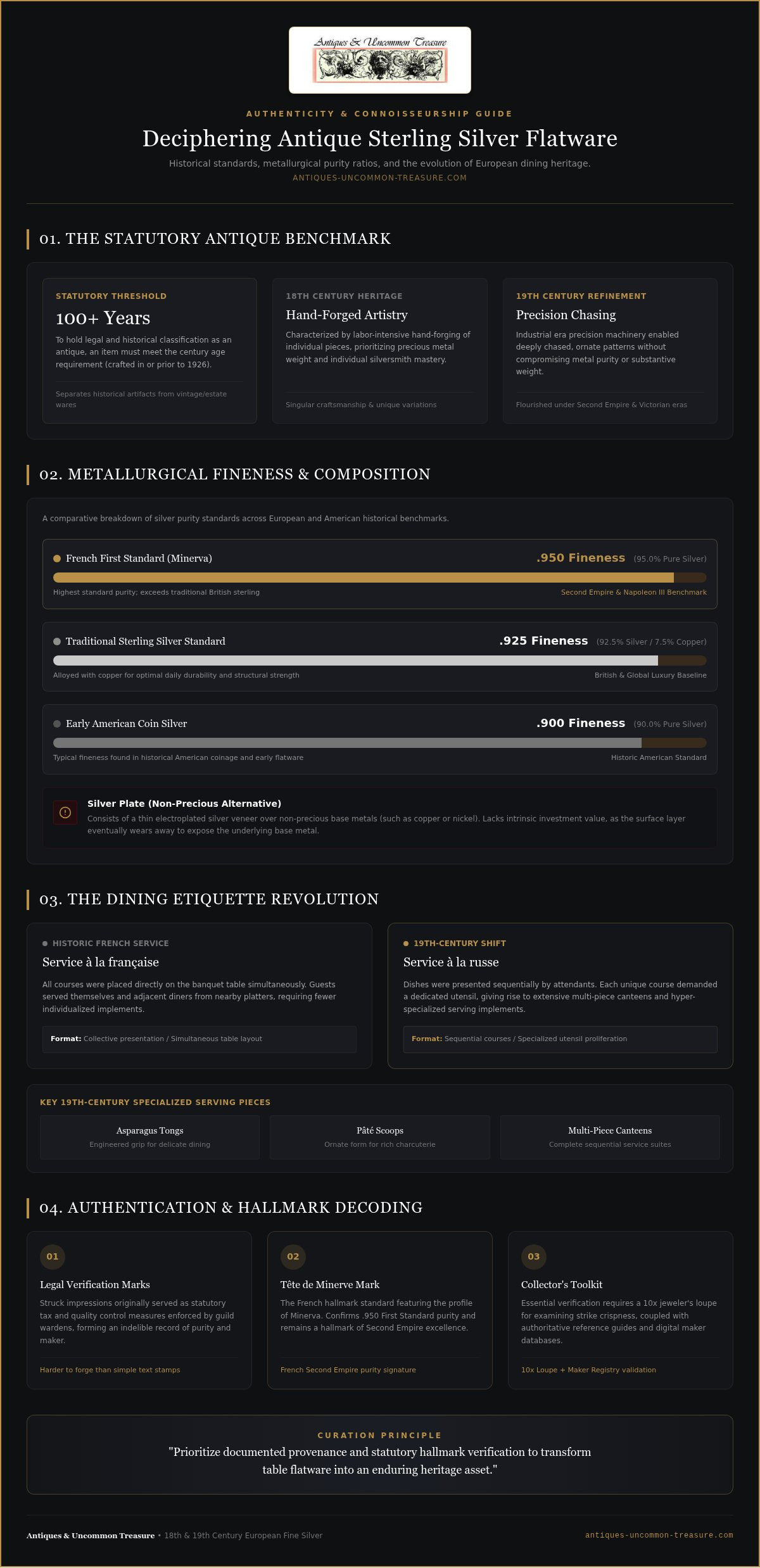
The term antique sterling silver flatware carries a specific legal and historical weight, referring to pieces that have survived for at least a century while meeting rigorous purity standards. In 2026, an object must have been crafted in or prior to 1926 to earn the statutory title of an antique, a benchmark that separates true historical artifacts from more recent vintage or estate wares. These objects represent a pinnacle of metallurgical art that balances intrinsic precious metal value with the exquisite hand of the master silversmith. While the 18th century was defined by the labor-intensive hand-forging of individual pieces, the 19th century introduced a period of industrial refinement where precision machinery allowed for more complex, deeply chased patterns without sacrificing the weight or purity of the metal.
The Social Ritual of the 19th Century Table
The Victorian and Napoleon III eras transformed the dinner table into a theater of social standing, where the abundance of silver signaled both wealth and cultural literacy. As the Industrial Revolution progressed, silversmiths expanded their repertoires to include an astonishing variety of specialized utensils, ranging from delicate asparagus tongs to ornate pâté scoops. This proliferation was driven by a fundamental shift in dining etiquette, moving from service à la française, where all dishes were placed on the table simultaneously, to service à la russe. In this newer style, courses were served sequentially by attendants, requiring a fresh set of implements for every dish and vastly increasing the demand for comprehensive, multi-piece canteens that reflected the owner's sophisticated taste.
Material Excellence: Sterling vs. Silver Plate
For the discerning collector, the distinction between solid silver and its plated counterparts is a matter of both durability and lasting legacy. Sterling silver is an alloy containing 92.5% pure silver and 7.5% other metals, usually copper. This specific sterling silver standards and composition ensures that the metal is hard enough to withstand the rigors of daily use while maintaining the lustrous white glow that defines high-purity silver. In contrast, silver plate consists of a thin veneer of silver electroplated over base metals like copper or nickel. While these pieces may initially mimic the appearance of solid silver, they lack the investment value of antique sterling silver flatware, as the plating eventually wears away to reveal the duller, non-precious metal beneath. Coin silver, often found in early American pieces, typically holds a lower fineness of .900, further reinforcing why sterling remains the undisputed standard for luxury tableware.
Deciphering Hallmarks and Authenticity Markers
Hallmarking serves as a sophisticated system of legal verification that has protected consumers for centuries. Unlike modern mass-produced items, antique sterling silver flatware carries a series of small, struck impressions that act as a permanent record of its origin, purity, and maker. These marks weren't originally intended for collectors; they were rigorous tax and quality control measures enforced by guild wardens. To appreciate the history of table flatware and specialized servers, you must first learn to read these microscopic signatures that separate a masterpiece from a common imitation.
A serious collector requires a few fundamental tools to unlock these secrets. A high-quality 10x jeweler’s loupe is indispensable for examining the crispness of a strike, while authoritative reference guides provide the necessary context to identify obscure regional offices. Don't be misled by a simple "Sterling" stamp alone. While this mark is standard on American pieces, authentic European silver relies on a complex sequence of pictorial hallmarks that are much harder to forge. Digital databases now complement traditional printed guides, allowing for the rapid cross-referencing of maker’s marks and date letters to verify a piece's provenance with absolute certainty.
Identifying French Silver Hallmarks
The French system is particularly elegant, utilizing pictorial symbols that have remained remarkably consistent since the early 19th century. The most critical mark is the Tête de Minerve, or head of Minerva, struck within an octagonal cartouche. Authentic French antique sterling silver flatware of the highest quality will feature the numeral "1" beside Minerva’s forehead, indicating the 1st Standard of .950 purity. Pieces marked with a "2" represent the .800 Second Standard, which is often found in smaller items or regional wares. You should also look for the poinçon de maître, the maker’s personal mark, which is traditionally housed within a diamond-shaped cartouche to signify solid silver rather than a plated alternative.
British and American Marking Systems
British silver utilizes a distinct set of four or five marks, including the iconic Lion Passant, which guarantees a minimum fineness of .925. By examining the specific font and shield shape of the date letter, you can pinpoint the year of manufacture with precision. You might also find a duty mark, often the profile of the reigning monarch, indicating that the appropriate tax was paid to the crown. American makers followed a different path. While firms like Tiffany & Co. and Gorham eventually adopted the "Sterling" stamp in the mid-19th century, earlier American pieces often bore only the maker's name or "Coin" silver marks. Understanding these nuances is essential for building a collection of true heritage. You can begin your journey by examining the meticulously hallmarked French silver within our current inventory.
The Elegance of French Sterling Silver and Napoleon III Design
While many collectors begin their journey with American or British makers, the true connoisseur often finds the ultimate expression of the craft in French antique sterling silver flatware. French silversmithing reached a zenith during the 19th century, particularly under the reign of Napoleon III. This era, known as the Second Empire, was characterized by a grand revivalism that drew inspiration from the Louis XIV, XV, and XVI periods. The result was a style of unparalleled opulence, where heavy-gauge silver was transformed into sculptural art. Designers favored deeply chased acanthus leaves, rococo shells, and neoclassical silhouettes that lent a sense of permanence and gravity to the dining table.
Much of this luxury was centered in the Palais Royal, the prestigious Parisian arcade that served as the heart of the luxury trade. Here, elite clientele sourced rare novelties and complete services that defined European high society. To ensure the integrity of these substantial investments, the French assay system utilized rigorous hallmarking and authenticity markers that still guide collectors today. Unlike the lighter weights often found in mass-produced items, French silver of this period possesses a tactile density that is immediately evident when held. This quality reflects a time when the dining room was the center of social life and every implement was expected to be a masterpiece of both form and function.
Master Silversmiths of the French Tradition
The names Odiot, Christofle, and Puiforcat represent the aristocracy of the silversmithing world. Odiot was renowned for its sculptural brilliance, often serving royal houses across Europe with massive, ornate centerpieces and flatware that pushed the boundaries of the medium. Christofle, while famous for its innovations in plating, produced sterling lines of exceptional quality that showcased the height of Parisian taste. Puiforcat transitioned from traditional 19th-century styles to Art Deco masterpieces, demonstrating a versatility that kept the firm at the forefront of design for generations. These makers didn't just follow trends; they established a global standard for luxury that continues to influence modern aesthetics.
Rare and Specialized French Serving Pieces
The French dining tradition celebrated the specific, leading to the creation of highly specialized implements that are now prized by modern collectors. The service à poisson, or fish service, often featured intricate engravings of aquatic life and pierced work that added a layer of delicate beauty to the meal. Other unique items, such as the gras de mouton or bone holders, highlight the meticulous attention to detail required in 19th-century service. Incorporating French sterling silver into a modern curated table allows these historical narratives to continue, bridging the gap between ancestral ritual and contemporary elegance.
Building a Curated Collection: From Place Settings to Servers
Building a collection of antique sterling silver flatware is a deeply personal endeavor that balances historical curiosity with functional utility. While many beginners feel compelled to acquire a monolithic, 120-piece canteen from a single maker, there is a growing appreciation for the 'mixed-maker' or eclectic collection. This approach allows you to curate a table that tells a broader story; perhaps you might combine the heavy-gauge elegance of a 19th-century French dinner fork with the delicate chasing of a Georgian tablespoon. By prioritizing essential pieces first, specifically the dinner fork, knife, and tablespoon, you create a foundation that is immediately usable for contemporary entertaining.
Beyond the standard place setting, the true allure of a collection often lies in 'uncommon objects' that reflect the specific dining rituals of the past. Seeking out rare implements such as marrow scoops, stilton scoops, or ornate asparagus servers adds a layer of sculptural interest to your display. When evaluating these pieces, you should distinguish between damage and honest patina. A fine network of microscopic scratches, often called a 'butler’s finish,' is a desirable sign of age that gives antique silver its characteristic soft glow. Conversely, deep pitting or loss of detail from over-polishing can significantly detract from the item's historical value.
The Hunt for Rare Patterns and Makers
Researching the dates when specific patterns were discontinued is a vital step in understanding rarity. Some designs were produced for only a short window, making them significantly harder to source than enduring classics. You'll also encounter the question of monograms. While some buyers prefer 'clean' silver, a beautifully engraved family crest or cipher adds an authentic historical narrative to a piece, linking it to a specific lineage. When you're ready to expand your service, sourcing from reputable dealers who specialize in authentic antique flatware ensures that every acquisition is backed by expert verification.
Care and Preservation for the Modern Home
The greatest myth regarding fine silver is that it should be reserved for special occasions. In reality, regular use is the best way to prevent the heavy, dark tarnish that occurs when silver sits idle in a drawer. The natural friction of handling and gentle washing keeps the surface bright. For cleaning, you should avoid abrasive polishes and never use ultrasonic cleaners, as these can strip away the delicate oxidation that defines the pattern's depth. Proper storage is equally critical. Use specialized silver cloth rolls and avoid rubber bands or plastic wrap, which contain sulfur and other chemicals that can permanently scar the metal's surface.
The Antiques & Uncommon Treasure Experience
Established in 2002, Antiques & Uncommon Treasure has spent over twenty-two years meticulously sourcing the finest examples of European craftsmanship for a discerning national audience. Our journey began with a profound appreciation for the tangible narratives embedded within historical objects, a commitment that has only deepened throughout our decades in the fine antique market. We don't merely offer inventory; we curate a collection of uncommon treasures that have been selected for their exceptional artistry, historical provenance, and enduring quality. This long-standing presence as a trusted authority reflects a dedication to authenticity that ensures every piece of antique sterling silver flatware we offer is a genuine artifact of its era, preserved for the appreciation of future generations.
Our philosophy centers on the idea that these objects are more than just functional tools; they're bridges to a more elegant past. By maintaining a patient, gallery-like atmosphere in our online presence, we allow collectors to explore the nuances of each item without the aggressive pressure of modern e-commerce. We see ourselves as stewards of history, carefully examining the hallmarks, weight, and chasing of every spoon and server to ensure it meets the high standards our clients expect. This methodical approach has allowed us to build a reputation for reliability and expertise that spans over two decades of successful sourcing and curation.
Our Specialization in French Silver and Art
Our expertise is particularly focused on the opulent designs of the Napoleon III era and the exquisite luxury novelties once found in the prestigious Palais Royal. We understand that for the modern connoisseur, the appeal of French silver lies in its superior purity and the high-relief sculptural detail that defines the height of Parisian silversmithing. Within our curated inventory, you'll find pieces that exemplify the tactile beauty of .950 silver, ranging from substantial dinner services to rare, specialized serving implements that are increasingly difficult to locate in the global market. We take great pride in assisting collectors across the country in their search for those elusive pieces that complete a family service or act as a striking, functional centerpiece for a contemporary dining experience.
Begin Your Collection Today
We invite you to linger over the intricate details of our historical inventory, where the methodical, deliberate pace of a fine gallery experience replaces the hurried urgency of modern commerce. Whether you're an established collector or just beginning to explore the refined world of 19th-century elegance, our team provides the professional consultation and historical insight necessary to make a truly informed acquisition. We ensure that the transition of these treasures from our collection to your home is handled with meticulous care, offering secure national shipping and a level of personal service that reflects our deep respect for the heritage we represent. It's our privilege to act as a sophisticated bridge between the master silversmiths of the past and the dedicated collectors of the 21st century. You can explore our collection of rare French sterling silver to find the next legacy piece for your own table.
Cultivating Your Legacy in Silver
Acquiring antique sterling silver flatware is an act of preservation that connects your modern table to the grand social rituals of the nineteenth century. By mastering the intricate language of hallmarks and recognizing the superior weight of French First Standard silver, you transform a simple purchase into a curated investment in art history. These pieces represent a time when every utensil was a sculptural masterpiece, designed to be used and cherished across generations. Whether you're drawn to the exuberant scrolls of the Napoleon III era or the refined silhouettes of the Palais Royal, each acquisition adds a new chapter to your home's unique narrative.
At Antiques & Uncommon Treasure, we've spent twenty-two years cultivating a national reputation for authenticity and historical detail. Our expertise in rare French sterling silver ensures that every item in our gallery has been selected for its exceptional provenance and craftsmanship. We invite you to Browse Our Curated Selection of French Sterling Silver Flatware and discover the uncommon treasures that will define your collection for years to come. Your journey toward a more elegant and meaningful dining experience begins with a single, perfectly balanced piece of history.
Frequently Asked Questions
Is antique sterling silver flatware safe to eat with?
Yes, it's perfectly safe and even beneficial due to silver's natural antimicrobial properties. You should enjoy your antique sterling silver flatware daily rather than reserving it for special events. However, avoid leaving it in prolonged contact with highly acidic foods like eggs or citrus, as these can cause surface pitting. Always hand wash your pieces with a mild detergent and dry them immediately with a soft cloth to maintain their lustrous finish.
How can I tell if my flatware is sterling or just silver plated?
Identifying solid sterling requires a careful examination of the hallmarks struck into the metal. Authentic antique sterling silver flatware will feature specific pictorial marks, such as the British Lion Passant or the French Minerva head, rather than just a simple manufacturer's name. If you see base metals like copper or nickel peeking through at the high points of the design, the piece is likely silver-plated. A professional jeweler's loupe is an essential tool for this verification.
What are the most valuable antique silver patterns to collect in 2026?
In 2026, collectors prioritize high-relief, ornate patterns from prestigious French makers like Odiot, Puiforcat, and Cardeilhac. Patterns from the Napoleon III era are particularly sought after for their sculptural density and historical opulence. Specialized serving implements, such as ornate fish slices or berry spoons with vermeil highlights, often command higher premiums than standard place settings. These pieces represent the pinnacle of 19th-century artistry and remain resilient investments within the fine antique market.
Does a monogram on antique silver lower its resale value?
A monogram doesn't necessarily diminish the value and can often enhance the piece's historical narrative. While some modern collectors prefer unadorned surfaces, a beautifully executed family crest or cipher provides tangible evidence of a piece's provenance. High-quality engraving was a significant expense in the 19th century, reflecting the status of the original owner. Unless the engraving is poorly executed or has been crudely removed, it should be viewed as a vital part of the item's heritage.
How should I store my silver to prevent it from tarnishing?
Proper storage involves protecting your pieces from sulfur in the air, which is the primary cause of tarnish. You should use treated silver cloth rolls or chests lined with tarnish-resistant fabric. Never use rubber bands, as the sulfur in rubber will cause permanent black scarring. Avoid plastic wrap or newspaper, which can trap moisture. The most effective way to prevent tarnish is simply using your silver regularly, as the friction of handling keeps the surface bright.
What is the difference between French .950 silver and British .925 sterling?
The primary difference lies in the fineness or the percentage of pure silver contained within the alloy. French 1st Standard silver, marked with the Minerva head and the numeral 1, contains 95.0% pure silver. This surpasses the British and American sterling standard, which requires only 92.5% purity. This higher silver content gives French pieces a distinctively white, luminous luster that connoisseurs find particularly appealing when building a high-end collection of European antiques.
Can I put antique sterling silver in the dishwasher?
You should never place antique silver in a dishwasher. The combination of intense heat, high-pressure water, and abrasive detergents will eventually dull the finish and cause a permanent gray film known as dishwasher spotting. Additionally, the heat can soften the resin or cement used to secure knife blades into their hollow handles, causing them to loosen or detach. Hand washing in warm, soapy water remains the only safe method for preserving these delicate historical artifacts.
What is a hallmark, and why is it important for silver identification?
A hallmark is a legal stamp used to guarantee the purity, origin, and maker of a silver object. These marks were enforced by assay offices to protect consumers from fraud and ensure that taxes were paid to the state. For the modern collector, they're the most reliable way to verify authenticity and date a piece with precision. Without these markers, it's nearly impossible to distinguish a genuine 19th-century masterpiece from a later, less valuable reproduction.