An authentic object of vertu is far more than a mere decorative relic; it's a silent witness to the cultural evolution of a nation that defined global luxury for centuries. You likely feel a profound sense of reverence when standing before a piece of 18th-century craftsmanship, yet that admiration is often tempered by the legitimate fear of mistaking a clever modern reproduction for a genuine legacy. The study of french antiques is vast and intricate, requiring both a keen eye for detail and a deep appreciation for the meticulous techniques that defined the golden age of European design.
This guide serves as your seasoned mentor, offering a clear framework to understand the distinct aesthetic shifts from the Rococo elegance of the 18th century to the refined opulence of the 19th century. We'll explore the complexities of French silver hallmarks, such as the elusive Minerva mark, and provide the confidence needed to identify rare Palais Royal items or Napoleon III jewelry. By the end of our journey, you'll possess the knowledge to curate a collection that honors the past while seamlessly enhancing your modern surroundings with pieces of enduring investment value.
Key Takeaways
- Master the distinct aesthetic transitions between the ornate Rococo of Louis XV and the structured Neoclassicism of the Empire period.
- Gain absolute confidence in identifying authentic sterling silver by decoding the intricate Minerva hallmarks and understanding period-specific manufacturing techniques.
- Discover the storied history of the Palais Royal to better recognize the exceptional craftsmanship of rare 19th-century sewing boxes and specialized tools.
- Learn to evaluate the delicate materials and historical provenance of portrait miniatures and Black Forest carvings to ensure your acquisitions are genuine masterpieces.
- Develop a sophisticated strategy for integrating rare french antiques into a modern home by focusing on thematic continuity and the selection of reputable, established dealers.
Understanding the Eras: A Timeline of French Antique Styles
The pursuit of authentic french antiques requires more than an appreciation for beauty; it demands a disciplined understanding of the historical currents that shaped every curve and hallmark. Identifying the specific period of a piece is the only reliable way to ascertain its true rarity and investment potential. Each era reflects the political and social climate of its time, moving from the exuberant curves of the mid-18th century to the structured, imperial aesthetics of the 19th century. Understanding these shifts allows a collector to see beyond the surface, recognizing the subtle cues that distinguish a genuine period piece from a later revival.
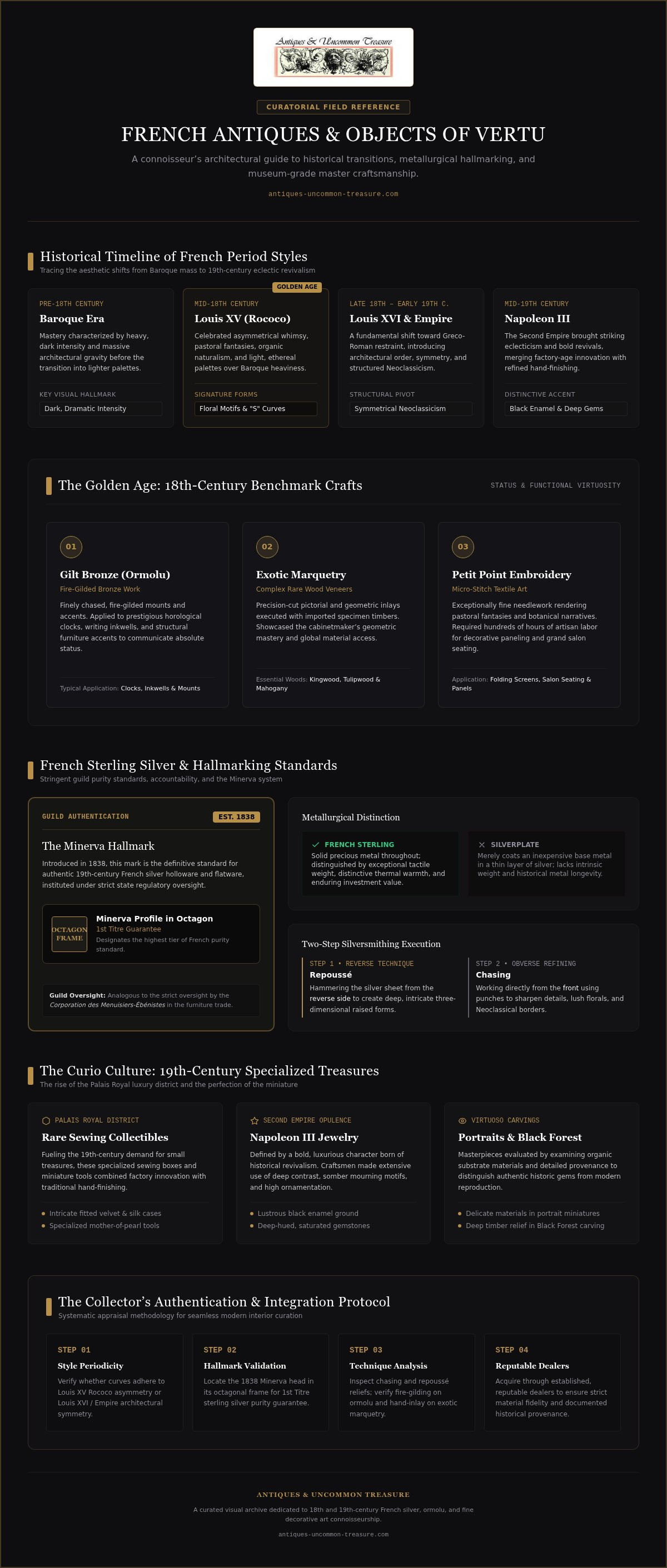
To truly appreciate these treasures, one must consult the timeline of French period styles, which illustrates the transition from the asymmetrical whimsy of Louis XV Rococo to the symmetrical, Greco-Roman restraint of the Louis XVI period. While the former celebrated floral motifs and "S" curves, the latter introduced a sense of architectural order that paved the way for the Neoclassical movement. This evolution wasn't merely decorative; it represented a fundamental change in the French approach to craftsmanship and luxury.
The Golden Age of French Craftsmanship
During the 18th century, the mastery of French tapestry and embroidery reached its zenith, characterized by a shift from the heavy, dark intensity of the Baroque into a lighter, more ethereal Rococo palette. Artisans utilized precious materials to create objects that were as much a display of status as they were functional items. High-end collectibles from this era often feature specific hallmarks of quality:
- Gilt Bronze (Ormolu): Finely chased fire-gilded bronze used for mounts and decorative accents on clocks and inkwells.
- Exotic Marquetry: Inlays of kingwood, tulipwood, and mahogany in complex geometric or floral patterns.
- Petit Point Embroidery: Exceptionally fine needlework used in screens, seating, and decorative panels that captured the era's pastoral fantasies.
19Th Century Innovation: Napoleon III and Beyond
The 19th century ushered in an era of remarkable eclecticism, particularly during the Second Empire. Napoleon III jewelry often features a bold, luxurious character, frequently incorporating black enamel and deep-hued gemstones that reflected the period's fascination with historical revival. This was also the age of the "curio" culture, where the popularity of the Palais Royal district fueled a demand for exquisite small treasures. From specialized antique sewing items to elaborate inkwells, these pieces demonstrate a unique blend of industrial innovation and traditional hand-finishing. It's this era that perfected the art of the miniature, creating a legacy of rare, accessible luxury for the modern connoisseur.
The Luster of History: Collecting French Sterling Silver
The allure of French sterling silver lies in its remarkable weight, its distinctive warmth, and the rigorous standards of purity that have governed its production for centuries. Unlike silverplate, which merely coats a base metal in a thin layer of silver, authentic French sterling is a solid investment in craftsmanship. For the discerning collector, these pieces represent a tactile connection to the past, where every spoon, tray, and tea set was a testament to the owner's status and the maker's virtuosity. In the world of french antiques, silver remains one of the most sought-after categories due to its enduring utility and the high level of artistic detail found in its execution.
The French system of hallmarking was historically among the most stringent in Europe, ensuring a level of accountability similar to the oversight provided by the Corporation des Menuisiers-Ébénistes in the furniture trade. This culture of excellence allowed for the development of complex techniques like repoussé and chasing. Repoussé involves hammering the silver from the reverse side to create intricate, raised designs, while chasing refines those details from the front. Together, these methods produced the lush floral motifs and neoclassical borders that define 18th and 19th-century French holloware.
Identifying Authentic French Hallmarks
Understanding silver hallmarks is the cornerstone of a serious collection. The Minerva head, introduced in 1838, is the most common mark found on 19th-century pieces. A Minerva profile inside an octagonal frame indicates "1st Title" silver, which is 950/1000 purity, actually exceeding the 925 standard of British sterling. Smaller items often bear the Boar's head or Crab mark, signifying silver assayed in Paris or the provinces. The "Grosse Garantie" was a larger stamp used on substantial pieces to certify that the proper tax had been paid and the purity verified, providing an additional layer of security for the buyer.
Investment-Grade Silverware and Tableware
When selecting investment-grade silver, the condition and weight are paramount. A heavy gauge of silver not only feels more luxurious in the hand but also resists the denting and wear that can plague thinner, mass-produced items. Collectors often seek out 19th-century flatware for its elegance and durability, finding that its patina-the soft, mellow glow developed through decades of gentle use-is far more desirable than a harsh, mirror-like polish. To maintain this value, it's essential to clean silver gently and avoid abrasive chemicals that can strip away the history of the piece. If you're ready to begin your journey, you might explore our curated selection of French sterling silver to find a piece that resonates with your personal style.
The Exquisite Palais Royal and Rare Sewing Collectibles
In the heart of Paris, nestled near the Louvre, the Palais Royal stood as the epicentre of 19th-century luxury. It wasn't merely a shopping destination; it was a curated experience where the elite sought out the most delicate french antiques. This historic arcade housed boutiques that specialized in "objets de vertu," small treasures that combined functional utility with breathtaking artistry. For the modern collector, items from this era represent a pinnacle of craftsmanship, where materials like shimmering mother-of-pearl, vibrant ormolu, and hand-painted enamels were used to create objects of unparalleled beauty.
The Palais Royal served as a sophisticated bridge between the era’s burgeoning industrialism and the timeless traditions of artisan workshops. These luxury goods often shared space with other small-scale masterworks, much like the history of portrait miniatures, which flourished alongside the rise of the specialized curio market. Owning a piece from the Palais Royal is akin to holding a fragment of Parisian history, reflecting the refined tastes of a society that valued the meticulous details of every personal accessory.
The Art of the Palais Royal Sewing Box
To the uninitiated, a sewing kit might seem mundane, but a Palais Royal sewing box is a masterpiece of miniature engineering. The true signature of these sets is the presence of small "pansy" marks on the ormolu tools, a subtle floral motif that serves as a hallmark of the finest boutiques. These boxes were typically crafted from exotic woods or fine leathers, with interiors lined in tufted silk and fitted with velvet-covered trays. Completeness is essential for value; a set that retains its original 18-carat gold-handled scissors, needle case, and thimble is a rare find. You should also look for the presence of the original mirror inside the lid, which was a standard feature of these high-end vanity items.
Other Palais Royal Curiosities
While sewing kits are the most famous exports of the arcade, the boutiques also produced an array of other "uncommon treasures." Antique inkwells made of faceted lead crystal and mounted on gilt-bronze bases remain highly prized by those who appreciate the tactile nature of historical writing instruments. Other sought-after items include:
- Miniature Perfume Bottles: Often encased in egg-shaped ormolu frames or delicate chatelaines.
- Vanity Items: Small hand mirrors and brushes featuring intricately carved mother-of-pearl handles.
- Desk Accessories: Letter openers and seals that showcase the same level of detail as larger french antiques.
These small items are ideal for modern collectors because they don't require vast amounts of space. They fit perfectly into glass display cases or on a library shelf, where their intricate details can be admired up close. Their enduring appeal lies in the fact that they were designed to be handled and cherished, making them a personal and intimate way to experience the history of French design.
Decorative Masterpieces: From Portrait Miniatures to Black Forest Carvings
The world of french antiques extends far beyond the gleam of metal and the structure of furniture, finding perhaps its most poignant expression in the intimate scale of decorative masterpieces. Portrait miniatures and Black Forest carvings represent two distinct yet equally compelling facets of 19th-century collecting. While one captures the delicate essence of the human spirit through fine brushwork, the other celebrates the rugged beauty of the natural world through masterful subtraction.
The Legacy of French Portraiture
Portrait miniatures were the personal keepsakes of their age, serving as portable mementos of loved ones long before the advent of photography. These tiny works of art required immense skill, often executed on thin wafers of ivory or vellum using specialized gouache and watercolor techniques. Collectors should look for the subtle stippling and cross-hatching that define the work of master miniaturists. Beyond traditional portraits, the 19th century saw a rise in "lover's eye" miniatures and mourning pieces, which often incorporated locks of hair or symbolic imagery. Because these are painted on organic materials, they're particularly sensitive to environmental changes. It's vital to keep them away from direct sunlight and areas of high humidity to prevent the ivory from warping or the pigments from fading.
Black Forest Carvings and European Folk Art
While many associate Black Forest carvings exclusively with Germany, the tradition actually finds its roots in Brienz, Switzerland, and became a staple of high-end European decor throughout the 19th century. These pieces offer a rustic sophistication that contrasts beautifully with more formal french antiques. Authentic Brienz wood carvings are characterized by their exceptional anatomical accuracy and the use of hard, dense lime or walnut wood. Common motifs include the iconic bears, noble stags, and intricate floral garlands that seem to breathe with life. When evaluating a piece, examine the depth of the carving and the quality of the patina; originals possess a rich, multi-layered finish that modern machine-cut reproductions simply can't replicate. The structural integrity of the wood, showing natural age-related drying without modern chemical fillers, is a hallmark of a genuine 19th-century treasure.
If you're looking to add a touch of historical character to your home, you can browse our collection of rare portrait miniatures and Black Forest carvings to find your next centerpiece.
Curating Your Collection: A Guide for the Modern Connoisseur
Building a collection of french antiques is an exercise in both patience and passion. A connoisseur might choose to develop a thematic collection, focusing perhaps on the intricate tools of the Palais Royal, or they may prefer the eclectic charm of selecting individual statement pieces that bridge different eras. Regardless of the approach, the goal is to acquire objects that resonate with a sense of personal history and aesthetic virtuosity. These pieces are more than just inventory; they're functional artifacts that carry the soul of the artisan into the modern era.
It's vital to partner with established dealers who possess a deep, specialized knowledge of art history and a proven reputation for integrity. With over 22 years of experience as an independent dealer, we understand that the value of an antique is found as much in its story as in its material. Researching the provenance of a new acquisition adds a layer of intellectual satisfaction to the process, allowing you to trace the lineage of a piece through its maker's marks and historical context. This meticulous approach ensures that your collection remains a source of pride and a sound investment for years to come.
The Online Acquisition Process
When acquiring treasures online, the relationship between the curator and the collector is paramount. You shouldn't hesitate to ask a dealer specific questions about the item's history or request a comprehensive condition report that details any historical wear. Detailed photography is essential, as it allows you to observe the fine nuances of a silver hallmark or the delicate brushwork of a portrait miniature from the comfort of your home. Because these items are fragile historical artifacts, it's crucial to confirm that the dealer employs specialized packing techniques and provides full insurance for the journey to your doorstep.
Integrating Antiques into Modern Decor
The most sophisticated homes treat antiques as living history rather than static museum pieces. An 18th-century silver tray, once a staple of formal service, can be repurposed as a refined organizer for a contemporary desk or a vanity. Similarly, displaying a series of portrait miniatures as part of a gallery wall creates a compelling visual dialogue between historical craftsmanship and modern design. These objects are the uncommon treasures that define a home's character, providing a sense of continuity that mass-produced items lack. To begin or expand your own journey into the past, you may explore our curated collection of French antiques and discover a piece that speaks to your unique style.
Embarking on Your Curatorial Journey
The journey through the history of French design reveals a world where utility and artistry are inextricably linked. By mastering the nuances of period styles and decoding the language of silver hallmarks, you transform from a casual observer into a discerning collector. Whether you're drawn to the intimate narratives of portrait miniatures or the structural elegance of Palais Royal treasures, each acquisition serves as a bridge to a vanished era of excellence.
As an independent dealer with over 22 years of expertise, Antiques & Uncommon Treasure prides itself on sourcing rare, museum-quality collectibles that honor this legacy. Every item is accompanied by detailed provenance and condition reporting, ensuring you build your collection with absolute confidence. Selecting authentic French antiques is an investment in the continuity of beauty, allowing you to surround yourself with objects that have withstood the test of time.
We invite you to browse our curated gallery of uncommon French treasures to find a piece that resonates with your style. May your search be as steady and rewarding as the history of the objects themselves.
Frequently Asked Questions
How can I tell if my French silver is sterling or silverplate?
Authentic French sterling silver is distinguished by specific official marks, primarily the Minerva head profile, which indicates a purity of 950/1000 for 1st Title silver. In contrast, silverplate often lacks these legal assay marks or may be stamped with "Metal Blanc" or a maker's mark within a square. You can also test the weight and thermal conductivity; sterling feels significantly heavier and warms rapidly when held in the hand.
What makes the Napoleon III era unique in French antique history?
The Napoleon III era, spanning roughly 1852 to 1870, is defined by its exuberant eclecticism and the revival of grand historical styles like Neo-Renaissance and Neo-Rococo. It was a period of immense innovation where traditional craftsmanship met the early industrial age, resulting in opulent jewelry and decorative arts. The era's unique character lies in its dark, dramatic palettes, frequent use of black enamel, and the rise of highly specialized luxury items.
Are Palais Royal items always marked with a specific brand?
Palais Royal items aren't always branded with a modern style logo, but they frequently bear subtle hallmarks of their origin. The most famous is the tiny ormolu pansy found on the tools of high end sewing sets. Many pieces were sold through independent boutiques within the arcade, so you may find specific maker stamps or simply the unmistakable combination of mother of pearl, fine silk, and superior ormolu that signifies their elite provenance.
How do I properly clean antique French sterling silver without damaging it?
Cleaning antique silver requires a patient, non-invasive approach to preserve the historical patina. You should use a soft, lint free cotton cloth and a mild, non-abrasive silver cream specifically formulated for antiques. Avoid modern "dips" or harsh chemicals, as these can strip away the delicate oxidation that defines the depth of chased or repoussé patterns. A gentle hand wash in warm, soapy water followed by thorough drying with a soft towel is often sufficient.
What should I look for when buying an antique portrait miniature?
When evaluating an antique portrait miniature, prioritize the quality of the brushwork and the condition of the base material, typically ivory or vellum. Look for exceptionally fine stippling or hatching that remains crisp under magnification. It's essential to check for signs of moisture damage, such as "blooming" or fading pigments, and ensure the ivory hasn't warped. Authentic pieces often retain their original convex glass and delicate gold or pinchbeck frames, which add significant historical value.
Why are Black Forest carvings considered French antiques if they originated in Switzerland?
While the tradition began in Brienz, Switzerland, these wood carvings are frequently categorized with french antiques because they were a staple of the 19th century French luxury market. The boutiques of Paris, particularly in the Palais Royal, were primary hubs for distributing these intricate works to international collectors. This shared European heritage and their prevalence in grand French estates have cemented their place within the broader canon of continental decorative arts and period collections.
Is it safe to buy high-end French antiques online?
Buying high end antiques online is safe when you engage with an established dealer who provides transparent documentation. At Antiques & Uncommon Treasure, we've spent over 22 years building a reputation for meticulous condition reporting and detailed photography. You should ensure the seller offers secure, insured shipping and is willing to answer technical questions about hallmarks or provenance. A reputable gallery acts as a professional guide, ensuring the item's historical integrity matches its digital presentation.
What is the significance of the ormolu technique in French decorative arts?
Ormolu, or "gilt bronze," is a cornerstone of French luxury, involving the application of high karat gold to bronze through a specialized fire gilding process. This technique allowed artisans to create decorative mounts and curiosities with a brilliant, durable luster that mimicked solid gold. Its significance lies in its ability to highlight the structural beauty of french antiques, from the frames of portrait miniatures to the intricate fittings on Palais Royal sewing boxes, signaling a piece's elite status and craftsmanship.